Context
PeakCore.dev started as a WordPress build — built from scratch, no demo imports, tuned to the same standard applied to every client project. It scored well: PageSpeed 99 on both mobile and desktop, Security Headers A+, SSL A. But it was still WordPress — a CMS, a theme, a page builder, a plugin stack, however lean.
The site is being rebuilt from scratch as a single hand-coded HTML/CSS/JS file — no CMS, no plugins, no framework. The goal isn't to fix something broken; the WordPress version already passed every check it recommends to clients. The goal is to remove the one remaining layer of overhead a technical SEO portfolio can remove: the platform itself.
Previous version — WordPress
Stack selected for performance before design: Astra Pro as the theme base for its minimal footprint, Elementor Pro for layout control, WP Rocket configured before any content was published, Cloudflare proxy active from day one.
No demo imports. Every section built from a blank canvas. Plugin count kept to the functional minimum. Images optimized before upload. Fonts self-hosted and loaded with font-display: swap. No render-blocking scripts.
Security headers implemented via .htaccess at the server level — the correct approach for a LiteSpeed server on Hostinger where Cloudflare proxy is active. All four critical headers configured with production-ready values including HSTS with preload and includeSubDomains.
Rank Math configured end-to-end: sitemap submitted to GSC, Organization schema, homepage title and meta description written to spec.
WP Rocket's built-in CDN was left inactive deliberately — Cloudflare already handles CDN delivery at the network layer, and activating both creates redundant URL rewriting. Combine JavaScript was left off, since on an Elementor site it can break widget interactions; defer + delay achieved the performance gain without that risk.
Now — hand-coded HTML/CSS/JS
The rebuild is a single HTML file — hand-written markup, CSS, and vanilla JavaScript, with no build step and no framework. Font loading was audited down to only the weights actually used in the type system, rather than the full range a Google Fonts default pulls in.
A bilingual EN/ES system was built from scratch — every string toggles client-side, with English as the default rather than relying on browser locale detection. Mobile behavior was verified directly in a real browser at multiple widths rather than assumed from desktop design.
Clean URLs are handled via a single .htaccess rewrite rule, keeping the file-per-page workflow already used across the rest of the site instead of moving to a folder-per-page structure.
Results — previous WordPress version
| Metric | Result |
|---|---|
| Security Headers | A+ |
| PageSpeed Mobile | 99 / 100 |
| PageSpeed Desktop | 99 / 100 |
| GTmetrix Grade | A · 86% Performance |
| LCP Mobile | 1.6s |
| CLS | 0.002 |
| SSL Labs | A |
| Total page size | 178 KB |
| Total requests | 27 |
Captured on the WordPress version, May 2026. New measurements for the HTML/CSS/JS rebuild will be added here once it's live.
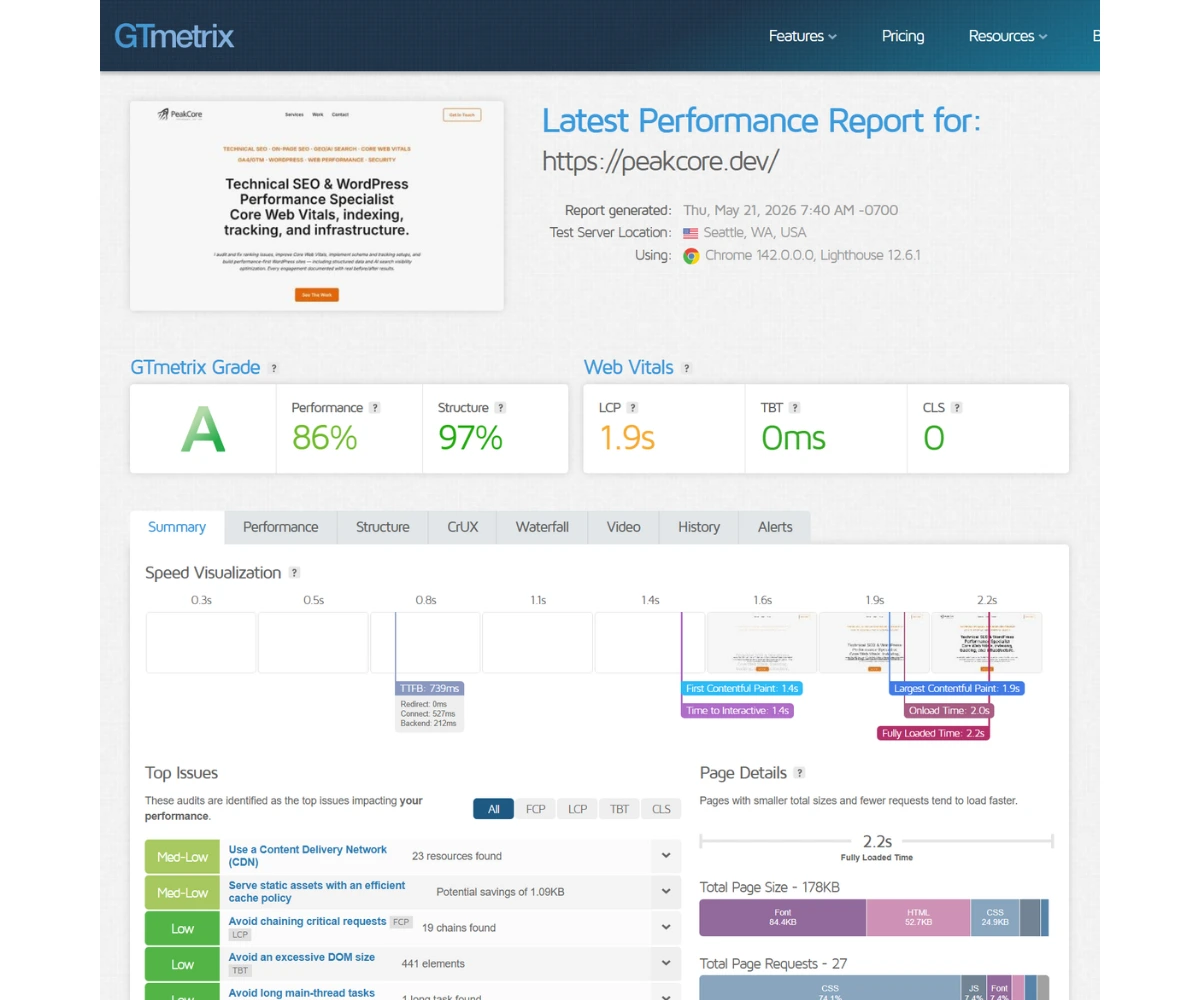
GTmetrix Grade A · Performance 86% · LCP 1.9s · CLS 0 · May 2026 · Previous WordPress version

PageSpeed Desktop 99 · Accessibility 91 · LCP 0.4s · May 2026 · Previous WordPress version

PageSpeed Mobile 99 · Accessibility 91 · LCP 1.6s · May 2026 · Previous WordPress version
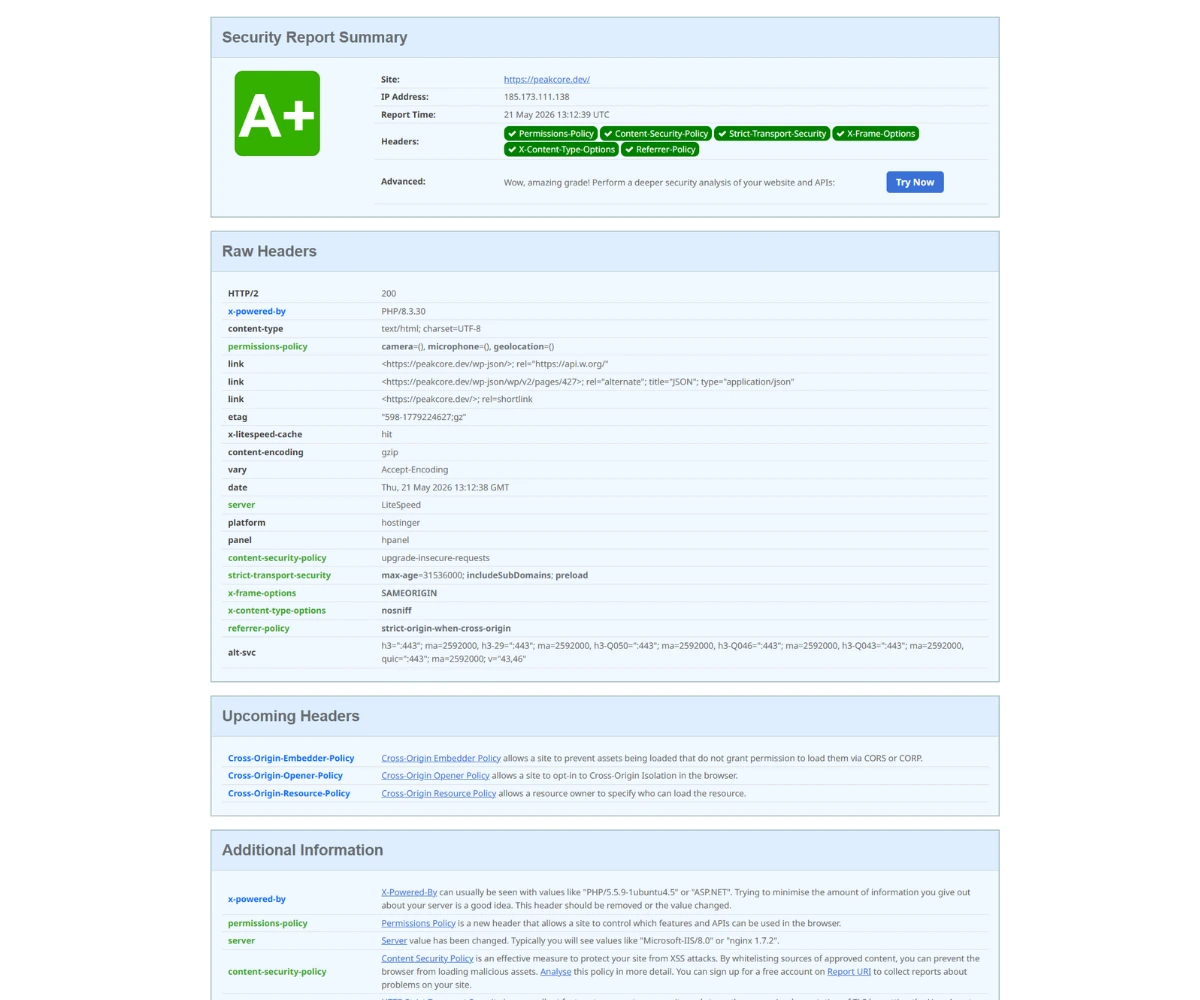
Security Headers A+ · All headers present · May 2026 · Previous WordPress version
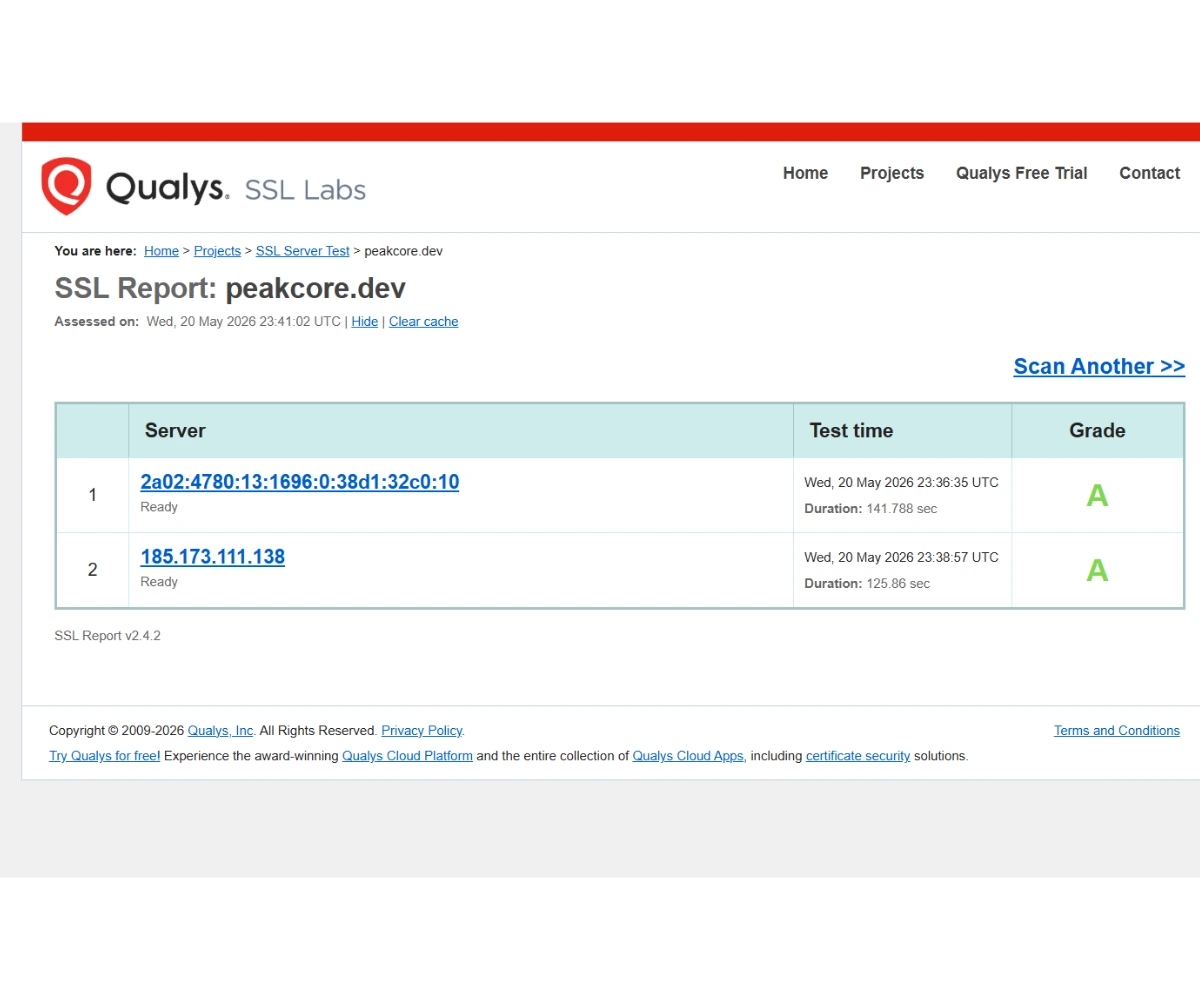
SSL Labs Grade A · 2 servers · May 2026 · Previous WordPress version
Why this case matters
Performance is a build decision, not a post-launch fix — and that applies even to a build that already scores well. A WordPress site with a disciplined plugin stack can hit PageSpeed 99. A hand-coded site with no CMS, no theme, and no plugin layer at all removes overhead that simply doesn't exist to optimize away in the first place.
This case will be updated with the rebuild's own measurements as it goes live — the same standard of verifiable, dated proof applied to every case in this portfolio.